Monday, August 29, 2011

Design of a Low-cost, Active Evaporation System

We wanted a preliminary conceptual design for a low energy, low cost, high volume fresh water evaporation system. 

Figure 1 illustrates the proposed system.  A high pressure pump forces water through an atomizing nozzle.  At the same time, a low-speed fan induces a stream of ambient air into the tank. The air exits the tank through a duct configured to form a vortex inertial separator.  A portion of the atomized water evaporates into the ambient air stream through the tank, while the remainder falls back to the reservoir or is collected in the inertial separator and directed back to the reservoir.

Figure 1.  Diagram of conceptual design

Performance
   The liquid water storage capacity depends only on the design choice of reservoir size.  The evaporation rate is also a design variable dependent on energy usage.  The table below shows two preliminary estimates of evaporation performance and energy usage detailed by fan and pump power for just one possible system configuration.  These are only very rough estimates and have not been experimentally validated.

evaporation capacity
pump power (est.)
fan power (est.)
3 liter/hr
1 W
21 W
1 liter/hr
0.37 W
8.2 W
Advantages
    The proposed system offers a number of significant advantages over conventional evaporation approaches: 

           Design freedom
The combination of a high pressure atomizer with an inertial separator allows great flexibility in system design by permitting trade-offs in individual component specifications.  In general, higher pressure water supply will result in smaller droplet size distributions from atomizing nozzles, however this costs more in pumping power and pump cost.  More expensive nozzles will produce smaller droplets and narrower droplet size distributions. Larger droplets can be produced less expensively in terms of nozzle and pumping costs, but they will require greater residence time for evaporation.  Higher air flow rates and higher air stream turbulence levels increase evaporation rates but cost more in fan power.  Trade-offs between various component costs (nozzle, pump, fan, inertial separator) and between capital and operating (energy) costs can be optimized to give excellent performance at minimum overall cost.  The inertial separator at the exit will insure that liquid water is contained so that wide variations in performance of individual upstream components can be tolerated while still resulting in an acceptable design.

Off–design operation
The same flexibility that allows for tremendous design freedom also permits the design of a very robust overall system.  Many factors including nozzle wear, off-design environmental conditions, water contamination, operator interference, control system failure, etc., can result in system operation at conditions outside of the original design parameters.  Ideally, a system will continue to give acceptable performance away from a single operating specification.  The flexibility inherent in this concept will easily allow for such a robust design. 

Evaporative cooling
In general, the evaporative cooling effect will result in a cool and moist air stream exiting the system.   This may be a primary aim or a desirable side effect.  This system maintains the principal advantage of a conventional evaporative cooling system—low operating cost--while avoiding the disadvantages inherent in maintaining a wetted media for evaporation – mold/fungus growth, higher pressure drop for the air system, and maintenance/replacement of the media.  


Friday, April 15, 2011

Ground-source Heat Engine Prototype Design and Test

Figure 1. Generalized Schematic
A company wished to explore feasibility and performance of ground-source heat engines designed to generate a tiny amount of electrical power from the daily fluctuating temperature difference between the air and the ground using solid-state thermoelectric generators. 

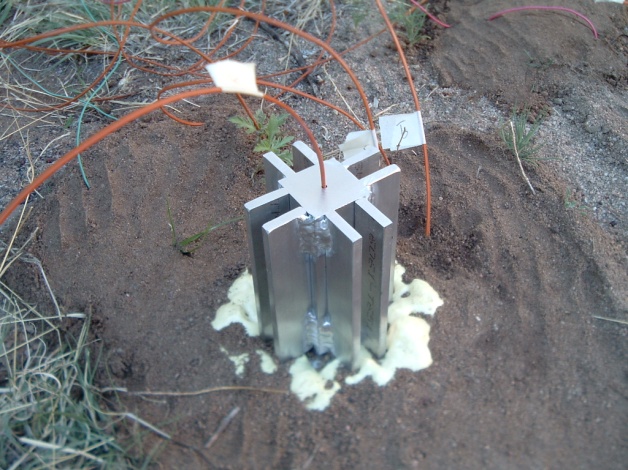
 Figure 1 shows the general structure of the device. Multiple thermoelectric modules were sandwiched between air-side and ground-side heat exchangers. The thermoelectric modules provided the electrical power generation from heat that flowed as a result of the air-ground temperature difference. The design consisted of appropriate geometric design for both heat exchangers, selection and interface configuration of the thermoelectric modules, and thermal resistance matching between the heat exchangers and the thermoelectric modules. 

Figure 2. Instrumented Prototype

 Prototype devices were designed and built. Figure 2 shows one of the prototypes situated in the test area and instrumented for performance evaluation. This prototype included fins on the air-side heat exchanger visible in the figure. Extended test results indicated peak power of 5 milliwatts and average power of 1 milliwatt could be obtained from the prototype configurations. It was determined that approximately 50% of the power generated in extended tests could be attributed to direct solar insolation. 


 Figure 3 shows a sample of measured power generation rates over a short part of the test period, and Figure 4 shows the total energy generated by hour of the day for the entire test period.
Figure 3. Measured Power
Figure 4. Total Energy

Friday, April 1, 2011

Parameter Simplification


It is often desirable to simplify heat transfer problems by working in dimensionless quantities. In some situations it is desirable to apply formal non-dimensionalization approaches such as the Buckingham Pi theorem. In other cases, there are obvious non-dimensional groups. Sometimes it is most convenient to only partly non-dimensionalize a problem. Normally, this process yields three significant benefits:

(1) it often simplifies the governing differential equation or the boundary conditions
(2) it results in a general solution (creates a fixed scale for the problem)
(3) it identifies significant groups

As an example, we can examine a simple textbook case.
      Consider 1-D, transient conduction in a plane wall with constant properties and a convective boundary condition at the front surface and a symmetry boundary condition at the rear surface.  The governing differential equation is:
and the boundary conditions are:
Note that there are 5 parameters in this problem (including boundary conditions): k, rho, c, L, and h.


We can non-dimensionalize using the following definitions:
in preparation for substituting into the original problem, these definitions can be re-arranged as follows:
substituting into the original differential equation:
cancelling terms leaves:

for the boundary conditions:
The group hL/k is commonly referred to as the Biot Number, Bi. From the definition of T*, it can be seen that the rest of the right hand side is simply T*(x*=1).

The final problem with boundary and initial conditions is now:


–Note that the parameter count has shrunk from five to one (Bi)

–The group that was termed t* is often called the Fourier Number, Fo.


Thursday, March 17, 2011

Transient Heat Transfer from a Buried Pipe

Figure 1. Computational domain and parameters

An accurate estimate of the heat transfer from a buried pipe to the surrounding ground is essential for the design of the ground loop portion of a ground-source heat pump. Exact analytical solutions to this problem are complicated by the fact that heat pump systems rarely operate continuously. Complete numerical simulations of system designs can be carried out, but these are unwieldy and difficult to justify for initial scoping calculations, or for preliminary performance estimates.  It was desirable to  develop  simple algebraic correlations that could be used to approximate the intermittent overall heat transfer between a fluid flowing in an isolated buried pipe and the surrounding ground.
Figure 2. Sample heat flow results
A finite difference model of this transient problem was developed in a SINDA-like numerical package.  Figure 1 shows the computational domain and system and material parameters that were used in the numerical model.  The model was exercised over a wide range of ground and fluid properties and operating conditions.  Figure 2 presents one sample set of results showing  dimensionless heat flow as a function of time at the pipe wall.  Algebraic correlations of the results were developed in order to provide readily accessible and simple design equations.  Figure 3 demonstrates the agreement between the dimensionless average heat transfer and the algebraic correlation as a function of dimensionless time.

Figure 3. Sample average heat flow results with algebraic correlation

References
J.W. Stevens, 2002, “Coupled Conduction and Intermittent Convective Heat Transfer From a Buried Pipe,”  Heat Transfer Engineering, Vol 23, n. 4, pp. 34-43.

J. W. Stevens, 2000, “Intermittent Convective Heat Transfer for Ground-source Heat Pump Design,”  Proceedings of the ASME Advanced Energy Systems Division – 2000, AES-Vol. 40, pp. 147-152.

J.W. Stevens, 1998, "Transient Heat Transfer Approximations for Ground-source Heat Pump Design,"  Proceedings of the ASME Advanced Energy Systems Division – 1998, AES-Vol. 38, pp. 415-424.


Friday, March 4, 2011

The Second Law of Thermodynamics (part 3)

A Third Statement of the Second Law
            A third way of stating the second law is to say that it is impossible to create a refrigerator that uses no power. This is equivalent to saying that, by itself, heat always flows from a warmer place to a cooler place. Recall that the purpose of a refrigerator (or air conditioner) is to take heat out of a cool place and move it to a warm place. According to this statement of the second law, this won’t happen spontaneously. Therefore, a common way for a refrigerator to function is to establish a region that is even colder than the space to be cooled, and a separate region that is even hotter than the spot where the heat is to go. However, in doing this, we have added something to our original setup, i.e. the refrigerator along with its associated input of power. 
Now, if it were possible to build a refrigerator that did its job without any input of power, we could take such a refrigerator, enclose it in a box, and use it to make heat flow spontaneously from a cooler place to a warmer place. Such a device has never been demonstrated and would violate the second law. Thus, saying that heat always flows down a temperature gradient is equivalent to saying that it is impossible to build a refrigerator that requires no power. 
            In a similar way, this statement of the second law implies, and is implied by the first statement that we used, i.e. that it is impossible to convert all heat into work. Recall that a heat engine is a device that operates between a hot reservoir and a cold reservoir and produces work. But if it were possible to build a refrigerator that did not require any work to operate, we could imagine a composite device consisting of a normal heat engine combined with a refrigerator that uses no work. 
The net result of the composite device would be a heat engine that changed all heat into work which would violate the second law. 
Alternately, we could imagine a composite device where a normal refrigerator was connected to a device that converts all heat into work. The combined device would violate our third statement of the second law since it would move heat from a cool place to a warm place without any input of work.


Summary
          The Second Law of Thermodynamics is based on the experience of many years of observations and is as solidly grounded as the First Law of Thermodynamics. It can be expresed in many different ways but all the expressions imply one another. The second law establishes values for different forms of energy, allowable directions for processes, and theoretical limits on all heat engine efficiencies.

Friday, February 18, 2011

The Second Law of Thermodynamics (part 2)

A Second Statement of the Second Law
            A second way of stating the second law is sometimes phrased as something along the lines of “the entropy of the universe always increases.” For the purposes of thermodynamic calculations a property can be defined called “entropy.” This property is very exact and rigorous in a quantitative way, and can be used for both practical and theoretical calculations. However, for the purposes of this discussion, it will serve to think a little more loosely of entropy as being representative of the amount of “disorder” in a system. This expression of the second law signifies that for any real process the disorder of the universe will increase. It is important to note the part about “the universe”. That is, for any particular system going through a process the entropy may increase or decrease. However, if it decreases, then we can be sure that the increase in the entropy of the surroundings (i.e. the rest of the universe) caused by the process is bigger than the decrease in entropy was for the system. 
            This statement of the second law leads to the thermodynamic equivalent of the “frictionless pulley”, i.e. it establishes a hypothetical standard against which real processes can be measured. This standard is the very best that could theoretically be achieved by any process. For some processes (those in which no heat is transferred) this theoretical limit is for the process to occur with zero increase in entropy of the universe. That is, actual processes will have an increase in entropy, theoretically ideal processes will have no increase in entropy and no process is even theoretically possible in which the entropy of the universe decreases. 
            This limit, along with similar limits for processes that do include heat transfer, is often utilized as a check by people who are tasked with evaluating proposed inventions involving energy transformations. Before investing the effort to understand and evaluate all the details of what might be a very complicated machine, the evaluator can simply check whether the overall operation of the device as described would result in a net decrease in entropy for the device and the surroundings. If it does, the device would violate the second law and cannot possibly function as described.

            A second implication of this expression of the second law is that all processes have directions in which they will proceed and directions in which they will not. The allowable directions will be those that result in an increase in entropy for the universe. Perhaps the easiest example of this to visualize is the case of a hot bowl of soup cooling off in a cool room. The room will never spontaneously cool off while the hot soup gets hotter even though such a process could be imagined that would not violate the first law. The total amounts of energy flowing are governed by the first law, and the direction is governed by the second law.
            This behavior of heat flow is sometimes expressed by saying “heat always flows downhill” where “downhill” is established by the temperature gradient. We’ll come back to this later as another statement of the second law, however, it is immediately clear that such an observation for heat is not stranger than the corresponding observation that “water always flows down hill” where “down hill” is determined by gravity, or a potential energy gradient.
            Many chemical processes have a particular direction in which they will proceed for a given set of conditions (temperature, pressure, concentration, etc.) and those directions are always in accord with the second law. Further, in some cases where it is not otherwise clear, it is possible to predict the direction of a reaction from second law considerations.
            Finally, it is worth noting that this statement of the second law is a preferred starting point for many of the philosophical discussions that are connected to thermodynamics. Some of the simplest and most profound of these deal with the beginning and end of the universe. For example, if the total entropy of the universe as a whole always increases, what will happen when a state of “maximum entropy” is reached? Will the universe ultimately “wind down” to a final state of complete uniformity? How did the universe get “wound up” in the first place? These and other questions flow directly from an understanding of the second law, and constitute what may be one of the more prominent and popular contact points between engineering and philosophy.

Friday, February 4, 2011

The Second Law of Thermodynamics

             A lot of engineering students wonder about the Second Law of Thermodynamics before taking the thermodynamics class, and many are still wondering after the class is over. Even though they can use the equations as directed, some students still wish that they had a better “feel” for the Second Law. In this post and the next couple, I’ll try to describe the Second Law of Thermodynamics in a qualitative way in order to help develop that intuitive feeling for this important fundamental and ubiquitous physical principle. 
            The Second Law shows up all around us. It appears in everyday experiences such as the cooling of a hot bowl of soup at breakfast and in more abstract applications such as establishing a theoretical upper limit on the efficiency of internal combustion engines, turbine engines, and steam power plants. In what follows, we’ll explore several equivalent statements of the second law and talk about some implications of those statements. 


Basis of the First and Second Laws
            Most people feel like they have an intuitive feel for the First Law of Thermodynamics which simply states that energy can neither be created nor destroyed. Energy can change forms; we often buy energy from a utility in the form of electricity, then convert that electrical energy into light, or heat, or vibrations of a stereo speaker, etc. However, a careful accounting of all of the energy involved in any such transformation will show that no energy appears or disappears in the process. This “law” is simply an expression of many observations: in all of history no one has ever been able to show that energy could be annihilated or created out of nothing. Those cases where somebody claimed such a process have, under careful scrutiny, always been shown to involve an error or a trick, but never a violation of the First Law of Thermodynamics. The Second Law of Thermodynamics is based upon a similar body of experience but for some reason it is much more common to find people proposing hypothetical devices or processes that would violate the second law than the first law. However, in all of history, spanning scales from sub-cellular processes to processes inside suns, nobody has ever found an exception to the Second Law of Thermodynamics. As with the First Law, it is really just a very distilled statement of an enormous number of observations, and seems to just be the way that the universe works.


One Statement of the Second Law
            There are many different ways of expressing the second law but in general, any one of them can be shown to logically imply all others. Each different expression usually has one or more classes of situations to which it is most applicable. In order to begin to get a feel for the second law we will consider several of these expressions and their implications.

            One way of stating the Second Law is to say that not all heat energy can be transformed into work. Before exploring that statement further, it is necessary to establish some nomenclature and definitions. In the language of thermodynamics, heat is energy that moves due to a temperature difference and work is energy associated with things like moving a force through a distance, a torque through an angular displacement or equivalent processes. (In fact, the fundamental distinction between heat and work is made on the basis of the second law.) We have use for both types of energy: we use heat to cook our food, warm our houses, sterilize medical instruments, etc., and we use work to turn the wheels on a car, or to turn the shaft of an electrical generator to produce electricity. Electrical energy, which is a form of work, can be used to power motors and electronic appliances, or it can be converted into heat as it is in toasters and electric ovens. A heat engine is any device that operates continuously to turn heat into work. Internal combustion engines, Stirling engines, and steam power plants all function as heat engines. Returning now to our statement of the second law, we see that this statement is saying that no heat engine can turn all heat into work. 
Some of the heat that is put into the heat engine from a high temperature source can be converted into work, but some (non-zero) fraction must be sent on as heat to some lower temperature sink. The amount of heat that is turned into work divided by the total amount of heat that goes into the heat engine is termed the thermal efficiency. The second law can be used to determine the maximum possible thermal efficiency for a heat engine. This maximum depends on both the high temperature at which heat is supplied and the low temperature at which it is rejected. Depending on how well it is designed, an actual engine might have any efficiency from zero up to the maximum, but no engine can have an efficiency better than the maximum efficiency determined by the second law. This statement of the second law also implies that different forms of energy have different values. That is, if all work can be converted into heat, but not all heat can be converted into work, then clearly work is more valuable to us than heat. This distinction is never made by the first law. The first law only accounts for total amounts of energy and ignores the value of different forms. The two laws are each useful in their own way.
 An illustrative comparison can be drawn by considering the way that we keep track of automobiles. For some purposes, such a sizing a parking lot, we are only interested in the number of cars. An expensive car does not take any more spaces than a cheap one. For other purposes, such as budgeting, the price of each car is every bit as important as the number of cars. It would be impossible to ignore automobile values and always deal only in numbers of cars. Similarly, for engineering purposes the second law is as important as the first law since it establishes the value of different forms of energy.

            Finally, the second law can be used to make a quantitative valuation of different forms of energy. For our purposes it will suffice to say that the valuation is made based on the percentage of energy that can be changed into work, and the higher the temperature, the bigger percentage and hence, the higher the value. Thus work is always more valuable than heat, and high temperature heat is more valuable than low temperature heat. This aspect of the second law is easily accessible from common experience. For example, there is an enormous amount of heat contained in warm ocean water, but because it is only slightly warmer than the air, it is very “low grade” heat, and it is very difficult to harvest it economically. On the other hand, a hot geothermal spring might contain much less total heat than, say, the gulf stream, but because it is at a higher temperature, it can be converted to work at a much higher efficiency.

Second Law, part 2

Second Law, part 3